The Patio Route That Keeps Chairs from Becoming Obstacles
Plan a patio route before placing furniture to keep doors, seating, and everyday paths working together without turning chairs into obstacles.
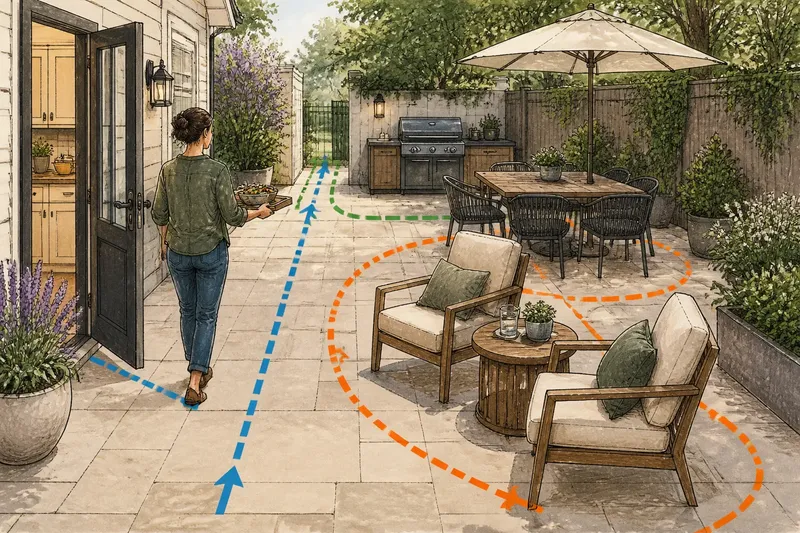
The common patio-layout mistake is placing chairs where they look balanced, then discovering that a pulled-out seat blocks the back door or the path to the grill. A clear patio route prevents that daily shuffle. Start with the entrances and the trips people actually make, then choose a layout approach that fits the patio’s shape and how it is used.
Begin With the Routes
A route is the space people need to move between destinations without dodging furniture. On a patio, the destinations might include a house door, steps to the yard, a grill, a gate, or a place to set down groceries. The route does not need to be a straight line, but it should be easy to recognize and use.
Notice what happens during an ordinary day. Someone may carry food from the kitchen to an outdoor table, walk from the door to a garden bed, or pass behind a seated person to reach the yard. The busiest route deserves the clearest passage. Less frequent trips can take a secondary path, provided it remains comfortable to use.
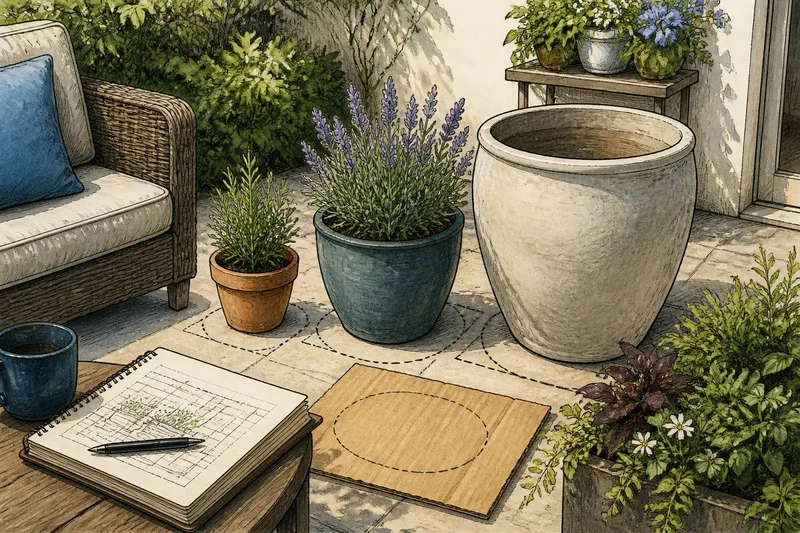
Mark the routes before moving furniture. Use painter’s tape on a hard patio, or place garden hose along the proposed path on a surface where tape will not stick. Walk the route with a laundry basket or serving tray held as you normally would. This makes tight turns and awkward door approaches easier to spot than looking at a plan alone.
Choose a Layout Approach
There are three useful ways to organize movement: keep a direct corridor open, route traffic around a seating area, or make a loop when the patio has several destinations. Each can work. The right choice depends on entry locations, patio width, and whether people need to pass through while others are seated.
Direct corridor
A direct corridor connects the main door to the most-used outdoor destination with a clear strip of space. Keep chairs, planters, and side tables outside that strip, including the area occupied when a chair is pulled out. This approach suits a narrow patio, a busy back entrance, or a route from the house to a grill or yard gate.
The tradeoff is that a corridor can divide the patio into separate zones. If the route runs between the door and the yard, dining or lounging furniture may need to sit on one side rather than spread across the full width. That is often preferable to forcing people to weave between chair backs.
Perimeter route
A perimeter route carries foot traffic around the outside edge of a seating group. It suits a patio with enough room to keep movement away from the middle, especially when people gather around a central table. Furniture can feel more connected because the walking line does not cut through the conversation area.
This approach is less useful when a narrow edge is already occupied by a wall, railing, or door swing. A route that pinches between a chair and a boundary may look open on paper but feel uncomfortable in use. Check the whole path, including turns and the space beside occupied seats.
Loop route
A loop gives people more than one way to reach common destinations. For example, someone can walk from the house to the garden without crossing the dining area, while another person approaches the table from the yard. This can suit a broad patio with several access points and frequent movement in different directions.
A loop uses more floor area than a single route. It may leave less room for furniture, so it is not automatically the best choice for a compact patio. Use it only where the second path serves a real destination or prevents a busy crossing through seated space.
Test the Full Chair Footprint
A chair occupies more room in use than it does when pushed neatly under a table. Count the chair’s pulled-out position, the person sitting in it, and the space needed to pass behind. The same principle applies to a recliner’s extended footrest and to a bench that people enter from the side.
Open each door and gate as far as it normally swings. Then check whether a chair, plant pot, or serving cart occupies that arc. A sliding door has no swing, but its handle and the area immediately outside the opening still need to remain easy to reach.
Say you have a back door near one corner, a grill along the far wall, and two chairs beside a small table. Imagine the shortest path from the door to the grill crosses behind one chair. Move the chairs toward the outer edge, tape a route from the door to the grill, then walk it while carrying a tray. If the tray clears the chair and the door opens freely, that placement is a better candidate; if not, shift the table or use a perimeter route instead.
Compare the Tradeoffs
The direct corridor is the simplest choice when one path dominates. A perimeter route protects a central seating area when there is room around it. A loop helps when the patio connects multiple active destinations. Avoid choosing by appearance alone: the best-looking arrangement in a sketch may interrupt the trip people repeat most often.
- Choose a direct corridor if most trips follow the same line and the patio is narrow or elongated.
- Choose a perimeter route if people need to move around a gathering without cutting through it.
- Choose a loop if several entrances or destinations create meaningful cross-traffic.
- Reconsider the furniture if every route collides with a chair, even after you shift the seating group.
That last decision matters. A smaller table, stackable chairs, or a bench placed against a wall may solve the conflict more cleanly than trying to preserve every piece in its current position. Keep the item that supports the patio’s main use and let the route determine where the rest can go.
Questions About Patio Routes?
How wide should a patio route be?
Make the route broad enough for the people who use it and the objects they carry, rather than relying on a line that looks passable when the patio is empty. Check it with a tray, basket, or mobility aid if one is part of everyday use, and allow extra room at turns.
Should the route pass behind dining chairs?
It can, if there is space for someone to sit and another person to pass without squeezing. If the path works only when chairs are tucked in, move the route or seating so ordinary use does not require constant rearranging.
What if the patio has only one entrance?
Connect that entrance to the most-used destination first, then see whether a secondary path is genuinely needed. A clear route to the yard or grill may be enough; do not spend scarce patio space on a loop with no useful second connection.
Can planters define a walking route?
Yes, a row of planters can make an edge easier to read, as long as the pots stay outside the usable passage and do not narrow a turn. Leave access for watering and plant care so maintaining the boundary does not block the route.
Keep the Route Legible
Once the layout works, use a few consistent cues to help people read it: keep the main passage visually open, align furniture edges rather than scattering them into the path, and avoid placing small tables where a turn begins. A rug can distinguish a seating zone, but it should not curl or shift into the walking line.
Recheck the arrangement after changing furniture or adding a planter. The route is not just the empty strip visible between objects; it includes chair movement, door access, and the space needed to carry things through. A clear patio route gives every piece a place without making everyday movement feel like an obstacle course.